
America at 250: How Transportation Networks Built a Nation
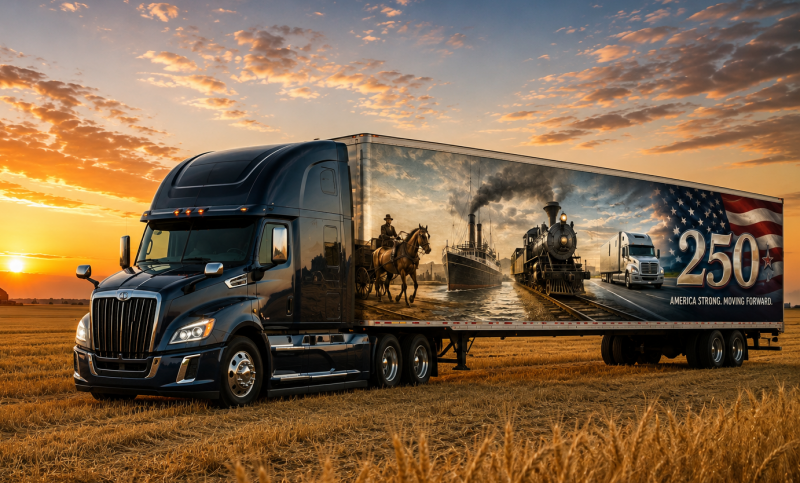
This year, America is celebrating its 250th birthday.
History books will rightly remember the presidents, inventors, entrepreneurs, pioneers, and visionaries who helped shape the nation. They will tell stories of independence, westward expansion, industrial growth, and technological breakthroughs.
Yet behind nearly every chapter of American history was another force quietly driving that progress. Every new settlement, every growing industry, and every expanding market depended on one simple idea: the ability to move people and products from one place to another.
Transportation rarely takes center stage in history books, but without it, many of America's greatest achievements would never have been possible.
Long before interstate highways, railroads, distribution centers, and real-time shipment tracking, merchants, farmers, and tradesmen had to figure out how to move flour from a mill to a frontier town. Lumber had to be hauled through dense forests to build homes. Iron, tools, livestock, and supplies all had to travel across a young country with few roads, even fewer bridges, and almost no infrastructure.
Every generation inherited the same challenge: How could goods be moved farther, faster, and more reliably than the generation before?
For the last 250 years, the answer to that question has quietly shaped the American economy.
When Every Mile Had to Be Earned
Life in colonial America demanded patience, determination, and resilience, especially when it came to moving freight.
Merchants loaded sturdy wooden wagons with barrels of flour, hand-forged tools, seed, animal feed, lumber, and other necessities before beginning journeys that often stretched across hundreds of miles. Every additional pound placed more strain on the horses pulling the load, and every mile presented another opportunity for something to go wrong.
There were no paved highways, weather forecasts, or fuel stations. In many parts of the country, there were no bridges across the rivers that separated a shipment from its destination.
Most roads were little more than narrow dirt trails carved through forests and farmland. During dry weather, wagons rattled over exposed tree roots and deep ruts worn into the earth by years of travel. After several days of rain, those same roads became thick ribbons of mud capable of swallowing wagon wheels almost to the axle.
Under ideal conditions, a heavily loaded wagon might have traveled only fifteen or twenty miles in a day. A broken wheel could leave merchants stranded for days as they searched for a blacksmith to make repairs. Rivers without bridges forced travelers to search for shallow crossings or wait patiently for ferries that might not arrive until the following morning.
Transportation was not simply another part of doing business. For many early American merchants, it determined whether the business survived. America was not short on ambition, but it was short on infrastructure.
America Keeps Moving West
Despite those challenges, the country continued to grow.
As settlers pushed beyond the original colonies, new farms, mills, foundries, and trading posts appeared farther inland. Communities expanded faster than transportation networks could keep pace. Farmers harvested more grain than nearby towns could consume, sawmills produced lumber for rapidly growing settlements, and iron works forged tools needed hundreds of miles away.
The demand existed. Moving products efficiently remained a challenge.
Entrepreneurs began constructing turnpikes, privately funded toll roads that offered smoother travel than muddy wagon trails. Although primitive by today's standards, they represented some of America's earliest investments in freight infrastructure.
At the same time, rivers became commercial highways. Flatboats carried tobacco, whiskey, grain, timber, and furs downstream toward larger ports along the Ohio and Mississippi Rivers. Returning upstream, however, remained difficult. Many flatboats were dismantled and sold for lumber because rowing them back against the current required more effort than they were worth.
That began to change in 1807 when Robert Fulton's steamboat, the Clermo relying entirely on wind or river currents. It marked an important turning point.Americans were no longer asking how to endure difficult transportation. They were beginning to ask how transportation itself could be improved.
That question led to one of the most ambitious infrastructure projects in the nation's history.
The Canal That Changed Commerce
When the Erie Canal opened in 1825, it transformed far more than transportation.
Stretching 363 miles across New York, the canal connected the Great Lakes to the Hudson River and New York Harbor, creating an efficient route between the Midwest and the East Coast. Before its construction, transporting a ton of freight just thirty miles inland often cost more than shipping that same ton across the Atlantic Ocean. The canal dramatically reduced both transportation costs and transit times, opening entirely new opportunities for commerce.
The canal itself became a remarkable sight. Teams of mules walked steadily along the towpaths, pulling long, narrow canal boats loaded with grain, lumber, iron, whiskey, and manufactured goods. At each lock, boats were raised or lowered through a series of massive gates that allowed them to navigate changes in elevation, an engineering achievement unlike anything most Americans had ever seen.
Farmers suddenly gained access to larger markets. Manufacturers expanded production because transportation was no longer the limiting factor. Towns along the canal grew into thriving commercial centers, proving that better infrastructure could create entirely new opportunities for business growth.
Water had transformed commerce, but it could not reach every corner of a rapidly growing nation.
Railroads Connect a Nation
As America continued expanding westward, transportation once again struggled to keep pace. The railroad answered that challenge.
Early steam locomotives captured the nation's imagination. Their whistles echoed across the countryside long before they appeared on the horizon. Thick clouds of steam and coal smoke announced their arrival as iron wheels thundered across newly laid tracks carrying freight farther and faster than anyone had previously imagined.
The completion of the Transcontinental Railroad in 1869 fundamentally changed American commerce. Travel that once required months could now be completed in days. Farmers throughout the Midwest reached customers on the East Coast. Coal, steel, lumber, livestock, and manufactured goods flowed across the country in unprecedented volumes. Manufacturers no longer thought only about serving nearby communities. They began serving an entire nation.
Industry Changes the Scale of Transportation
The Industrial Revolution introduced another challenge.
American factories became capable of producing goods at a pace that earlier generations could scarcely have imagined. Steel mills, textile factories, machine shops, and assembly lines transformed the nation's manufacturing capacity. The question was no longer whether products could be made. It was whether they could be delivered.
Steamships replaced sailing vessels throughout much of the world, carrying larger cargoes with greater reliability. Ports expanded to handle growing trade, and railroads continued pushing farther across the country.
By the early twentieth century, the internal combustion engine introduced yet another transformation. Trucks offered something railroads never could: flexibility. Freight no longer depended entirely on rail terminals or waterways. It could travel directly from the factory to the warehouse, from the warehouse to the retailer, and eventually to the customer. Transportation had become more responsive than ever before.
The Interstate Highway System Redefines Freight
The Interstate Highway System became the next great leap forward.
Authorized in 1956, the Federal-Aid Highway Act launched one of the largest infrastructure projects in American history. More than 48,000 miles of controlled-access highways eventually connected cities, manufacturers, warehouses, and distribution centers across the country.
Businesses quickly recognized the advantages. Instead of routing freight through multiple modes of transportation, trucks could deliver directly from origin to destination. Manufacturers shortened delivery times. Distribution centers were strategically positioned near major highways. Customer expectations evolved as dependable, faster delivery became the new standard.
The American trucking industry became the backbone of domestic freight movement, connecting businesses in ways earlier generations could hardly have imagined.
Modern Logistics Is More Connected Than Ever
Today's transportation and logistics networks would seem almost unimaginable to those early merchants navigating muddy wagon trails.
A single shipment may begin in an overseas manufacturing facility, cross an ocean aboard a container ship, continue inland by rail, transfer through a regional distribution center, and complete its journey by truck, all while customers track its progress from a smartphone.
Warehouses have evolved from simple storage facilities into strategic distribution hubs. Transportation management systems optimize carrier selection. Warehouse management systems provide real-time inventory visibility.Artificial intelligence and predictive analytics help businesses make better decisions before freight ever leaves the dock.
And while technology has changed dramatically, the mission has not. For 250 years, businesses have continued searching for better ways to move products efficiently, reduce costs, and serve customers more effectively.
Continuing the Tradition
America's transportation story has never been about wagons, canals, railroads, or trucks alone. It has always been about solving problems.
Each generation inherited a new challenge and found a better way to move goods than the generation before it. Every improvement expanded markets, created new opportunities, and strengthened the nation's economy. That spirit of innovation continues today.
At Amware, we're proud to carry that legacy forward. By integrating warehousing, transportation, distribution, and technology into seamless supply chain solutions, we help businesses move products with greater efficiency, visibility, and confidence.
As America celebrates 250 years of progress, transportation continues to connect businesses with customers, manufacturers with markets, and communities with opportunity. The equipment may have changed dramatically since 1776, but the goal remains remarkably familiar: finding smarter, faster, and more reliable ways to keep America moving.